 Photo: Edmond Dantès / Pexels
Case Study
Hiring & Recruiting Management with Jira Service Management
How to track and manage applicants in a growing company with Jira Service Management
The Starting Situation
Efficient applicant management is crucial for companies that want to attract and retain top talent. Jira Service Management is highly adaptable and can be used beyond its traditional role in IT service management to streamline and improve the applicant management process. Through workflow automation, customizable fields and collaboration features, companies can create a centralized, organized system for handling applications, tracking candidate progress and improving communication between hiring teams.
This use case examines how Jira Service Management is used as an applicant management tool. It shows how the platform can be configured to manage the entire recruiting lifecycle, from application submission through interview scheduling to offer creation.
Who Is This Solution For?
Whether you're a small business or a large enterprise, this guide shows you how to turn your hiring process into a seamless, efficient and transparent experience for applicants and hiring managers alike.
Integrating applicant management into Jira offers key benefits for growing smaller companies. It eliminates the need for additional software, reduces costs and leverages the team's existing Jira knowledge. This approach streamlines recruiting, improves collaboration and provides a scalable solution. By centralizing hiring activities in Jira Service Management, smaller companies can increase efficiency, keep organized records and focus more on finding top talent to drive their growth.
The Challenge
Recruiting can be a real challenge, especially when it comes to finding the best talent in today's competitive market. Small but fast-growing companies often find themselves in a bind – they need top performers but don't have the large budgets of their bigger competitors. This is a difficult situation many growing companies face when searching for talent.
This is where Jira Service Management comes in as an applicant tracking system. It was designed to solve some of the biggest problems that can hamper your hiring process:
- Fragmented hiring processes: when hiring information is scattered across different platforms, that's a recipe for chaos. Jira Service Management centralizes all hiring activities and ensures everything is in one place and easily accessible.
- Inefficient candidate tracking: losing track of where candidates stand in the pipeline? With JSM's customizable workflows, you can systematically track progress, from the initial application to the final offer.
- Lack of collaboration: miscommunication between HR and hiring managers can derail the process. JSM fosters real-time collaboration, letting team members seamlessly share notes and updates.
- Time-consuming manual tasks: drowning in repetitive tasks like scheduling interviews and sending follow-ups? Automation features take care of these tasks, freeing up time for more strategic work.
- Scalability concerns: as your company grows, so does your hiring need. Jira offers a scalable solution that easily adapts to rising application volumes and more complex workflows.
- Data management and reporting: evaluating hiring data is crucial for informed decisions. The tools' robust analytics help you track key metrics, identify bottlenecks and optimize your hiring strategy.
By addressing these issues, Jira Service Management enables smaller companies to compete in the talent market, even without the resources of larger companies.
The Requirements
Certain key requirements must be met for HR teams to effectively manage the recruiting process and overcome the challenges described. These ensure the recruiting process stays streamlined and efficient, and can meet the demands of a growing company.
- Centralized applicant tracking system: HR teams need a single platform to manage all recruiting activities, from job posting to applicant communication. This central system should provide easy access to applicant information, application status and communication logs, ensuring nothing falls through the cracks.
- Customizable workflows: recruiting processes vary widely from company to company, and even from one function to another within a company. HR teams need to be able to adapt workflows to their specific hiring stages, from initial screening to the final hiring decision. This flexibility ensures the system is aligned with the company's individual needs and processes.
- Seamless collaboration tools: recruiting is teamwork and requires input from various stakeholders, including HR managers, department heads and interviewers. HR teams need tools that enable seamless collaboration, so team members can share feedback, discuss candidates and make informed decisions together.
- Automated task management: HR teams need automated task management features to reduce administrative burden and increase efficiency. This includes automatically scheduling interviews, sending follow-up emails and updating applicant status. Automation lets HR staff focus on strategic tasks instead of repetitive administrative work.
- Reliable reporting and analytics: data-driven decision-making is crucial for optimizing recruiting processes. HR teams need robust reporting and analytics features to track key metrics like time to hire, source of hire and applicant drop-off rates. These insights help identify areas for improvement and make informed adjustments to the hiring strategy.
- Scalability and flexibility: as the company grows, the recruiting system must be scalable to handle a larger volume of applications and more complex workflows. HR teams need a solution flexible enough to adapt to changing requirements without significant reconfiguration or additional investment.
- Improved applicant experience: a positive applicant experience is crucial for attracting top talent. HR teams need tools that streamline communication, provide timely updates and ensure a smooth, professional experience for applicants throughout the hiring process.
- Security and compliance: security and compliance with data protection regulations must be ensured when managing applicant data. HR teams need a system that offers robust security features, access controls and compliance with relevant legal regulations to protect sensitive applicant data.
The Solution
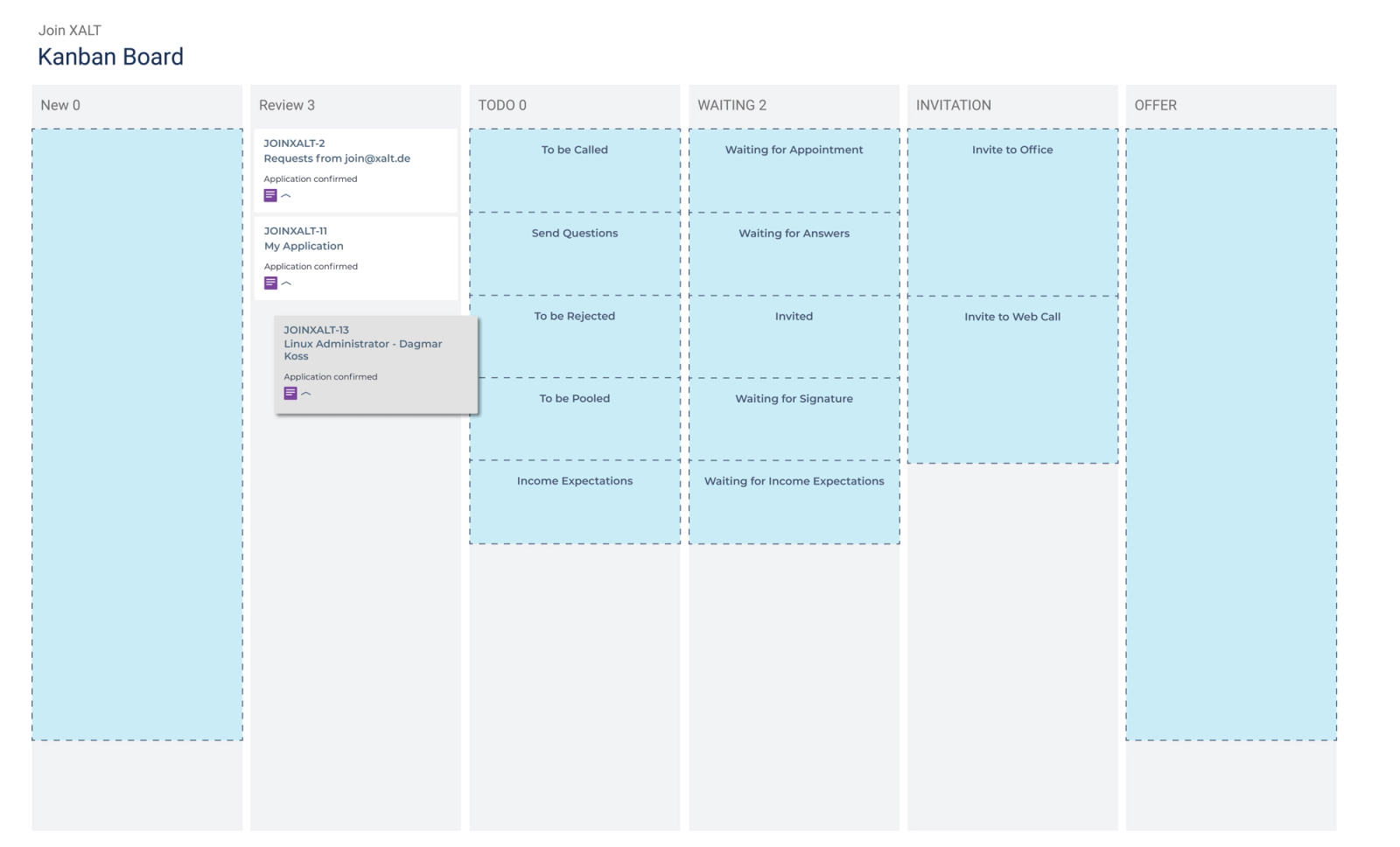
To overcome HR teams' challenges and meet their requirements, we developed a comprehensive applicant management workflow within Jira Service Management. This solution uses Jira's powerful features to optimize recruiting from application submission through to the final decision. Here's how the solution works:
By implementing this solution in Jira Service Management, HR teams can overcome the challenges of fragmented processes, inefficient tracking and poor communication. The automated, customizable workflow boosts efficiency and improves the applicant experience, making it easier for growing smaller companies to attract and hire the best talent.
Process Digitization with Jira & Jira Service Management
Maximize your teams' efficiency by digitizing and automating your business processes.
Tracking Data with Jira
A key benefit of using Jira Service Management for applicant management is the ability to track and analyze data throughout the entire hiring process. By capturing detailed information at every stage of the workflow, HR teams can create comprehensive reports on various key performance indicators (KPIs) to evaluate and optimize their hiring strategies.
Some of the important KPIs that can be tracked include:
- Time to hire: measure the total time from receiving an application to the final hiring decision. This KPI helps identify bottlenecks in the process and areas for improvement.
- Time to first interview: capture the average time it takes an applicant from submitting their application to their first interview. This metric is important for understanding how quickly initial screening and scheduling are carried out.
- Drop-off rate: analyze the stages where candidates are most likely to drop out of the hiring process. This helps identify potential issues with the applicant experience or selection criteria.
- Interview-to-offer ratio: calculate the ratio between interviews conducted and the number of offers extended. This KPI provides insight into interview effectiveness and the quality of candidates being sourced.
- Offer acceptance rate: monitor the percentage of offers accepted by applicants. A low acceptance rate can indicate issues with the offer package or the applicant's experience during the hiring process.
- Source of hire: determine which job posting platforms or referral sources are most effective at attracting high-quality applicants. This information can be used to target future recruiting marketing efforts.
By leveraging Jira Service Management's robust reporting and analytics features, HR teams can create detailed reports on these KPIs and more. These insights enable data-driven decision-making, letting companies continuously refine their recruiting processes, increase efficiency and improve the applicant experience. The ability to track and analyze data within Jira Service Management empowers HR teams to develop a more effective, responsive hiring strategy.
Conclusion
Using Jira Service Management for applicant tracking is a decisive advantage for growing companies. It brings everything under one roof, automates the boring stuff, and gives you a flexible workflow that fits your hiring practice. With the kanban board, it's a breeze to see at a glance where every applicant stands.
But here's where it really gets good: the reports. You can track how long it takes to hire someone, or how many candidates drop out. These aren't just numbers for the sake of numbers – they're information that helps you make smarter decisions and keep improving your recruiting.
For smaller companies already using the Jira ecosystem, it's a breeze. You don't have to learn a whole new system; it grows with your company. It directly solves the annoying problems of scattered information, losing track of applicants, and team miscommunication.
And the bottom line? Jira Service Management turns the chaotic business of recruiting into a smooth, efficient process. It's about working smarter, not harder, to find the best talent.
better call XALT
Digital Business Processes and Automated Workflows for More Performance and Efficiency
Digitize your business processes with Jira and digitally involve your employees, customers, service providers and partners – for seamless collaboration.