Hands on a laptop on a wooden desk, next to a calculator, a receipt roll and a notebookPhoto: Mikhail Nilov / Pexels

Case Study

Digital Invoice Management with Jira

Scan paper invoices, type up a Jira ticket, track down the right person: XALT digitized its own invoice process – a scanner, a script and a Jira board now handle it alone.

The Starting Situation

Our accounting manager at XALT faced a mountain of challenges every day, caused by our inefficient and largely manual invoice management.

Picture this: a stack of paper invoices on your desk, each one has to be scanned individually, entered correctly into the system (in our case, Jira), described by hand and assigned to a person in charge. At the same time, the phone keeps ringing, colleagues ask about invoice status due to a lack of transparency, suppliers are waiting for payments, and management urgently needs financial reports.

The consequences: invoices often sit unprocessed, errors creep in through manual steps, responsibilities aren't transparent, and valuable time is wasted searching for documents. This leads to delayed payments, frustrated suppliers, reduced productivity and rising frustration within the team.

Our goal was clear: we needed a digital solution for fast invoice assignment, improved traceability and remote access, to minimize manual effort as well as unnecessary internal communication. We wanted to boost efficiency, eliminate paper, and let our team focus on value-adding work.

A key part of our solution was the decision to use our existing ticketing system, Jira. For one thing, all employees were already familiar with the system. For another, Jira offers the technical capabilities to create transparency around processing status and responsibilities, as well as simple documentation of the entire processing workflow, from intake to completion.

The Process Before Implementation

1
Step 1

Receiving paper documents and scanning the document

2
Step 2

Creating a Jira ticket

3
Step 3

Adding a description, title, scanned files, and assigning a person in charge

4
Step 4

Starting to process the document

5
Step 5

Filing the document

6
Step 6

Closing the ticket

The Challenge

At XALT, but especially within our Operations & Accounting team, there were several challenges in digital invoice management:

  • Manual document assignment: the process was slow and cumbersome, leading to delays. Every step created manual effort: scanning the document, sending it to the person in charge, creating a ticket in Jira including a title and description of the document, and assigning it to a processor.
  • Poor traceability: it was difficult to track the status and person responsible for a document. People often had to ask, for example, what stage a given invoice was at or whether it had already been paid.
  • Limited remote access: team members from other office locations needed access to documents, but the lack of remote access options limited their flexibility and productivity.
  • Unorganized system: the system was poorly structured, making it hard to quickly find important documents, delaying decision-making and slowing down the people responsible for handling their tasks.
  • Paper storage: the space needed for paper documents grew significantly over the years, and as a digital company, XALT wanted to avoid paper wherever possible.

All of these points led to significant inefficiencies in invoice management and operational processes. The workflow was hampered by delays, errors and a lack of structured processes.

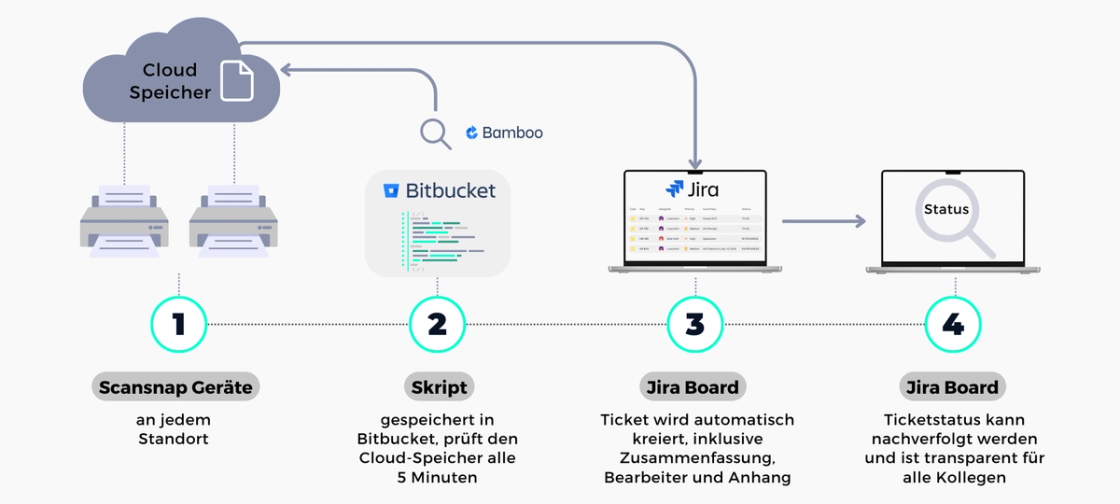
The new process in four steps: scanners deposit scans in cloud storage, a script checks every five minutes, Jira creates a ticket with attachment

Automatic/Digital Invoice Management Process

Implementation & Approach

We tackled these challenges by implementing a robust solution that digitized the manual process and automated it as far as possible. For that, we needed three things: a scanner with internet or cloud connectivity, a cloud storage service (e.g. Google Drive, Microsoft OneDrive or Dropbox), and Jira as the process digitization solution.

Implementing the New Solution

A scanner was set up in every office, connected to our cloud storage to deposit scanned documents there. A script, kept in our source code repository Bitbucket, runs automatically every 5 minutes to check our cloud storage for new files. When a new file is found, a Jira ticket is automatically created, containing a document summary (title) and the scanned file. The responsible person is automatically assigned to the ticket and receives a notification. The entire processing workflow for the document is tracked in Jira, keeping everything transparent and traceable.

To ensure a smooth rollout, XALT communicated the implementation plan and its benefits to all employees involved, including the accounting and legal departments.

Training sessions were also held to familiarize our employees with the new system, backed by ongoing support to resolve any issues that came up.

The New Process

1
Step 1

Installing a cloud-connected scanner in every office

2
Step 2

Script checks the cloud storage for new files every 5 minutes

3
Step 3

Automatic creation of a Jira ticket when a new file is found

4
Step 4

Ticket contains summary and file

5
Step 5

Assigning the ticket to a person

6
Step 6

Process tracking in Jira to ensure transparency and traceability
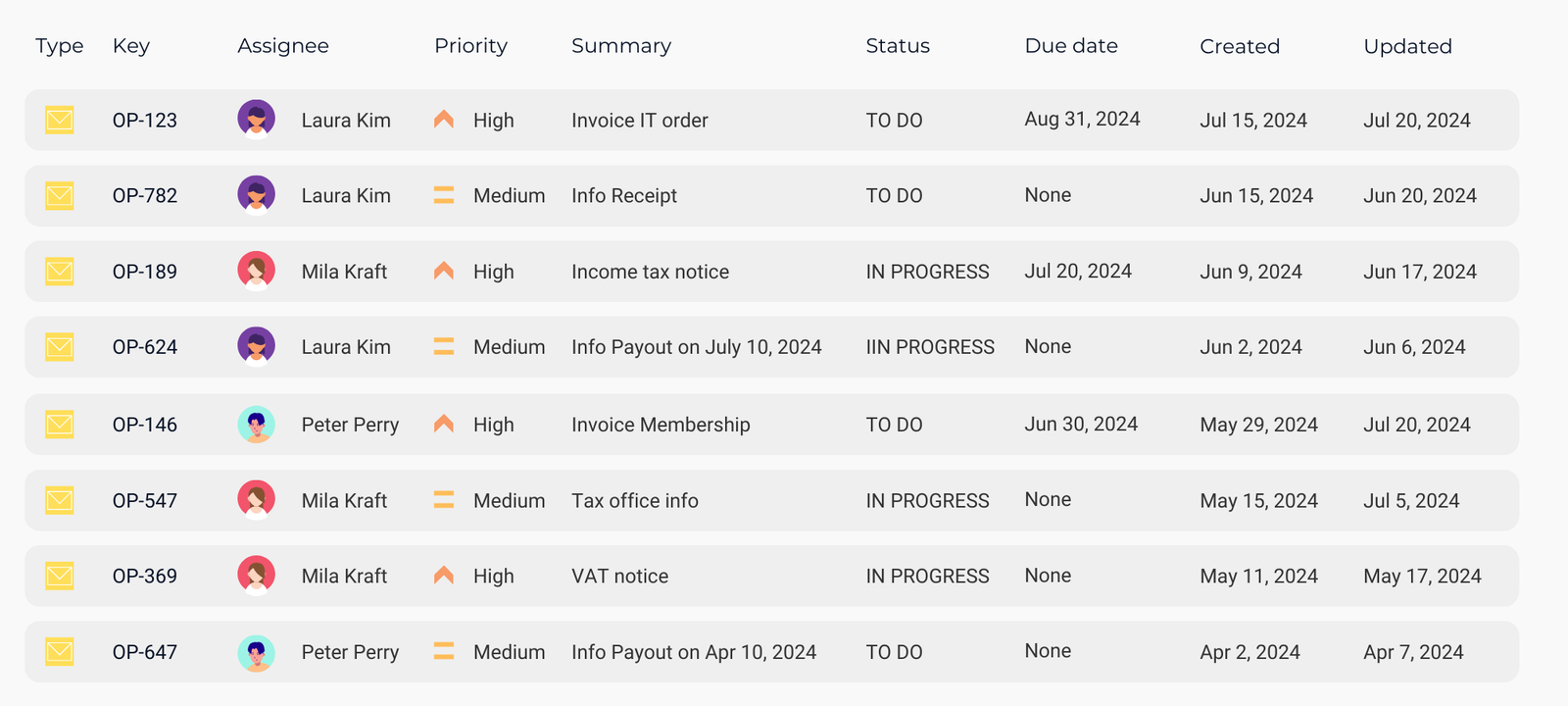
A Jira board as a table: each row an incoming document with ticket number, assignee, priority, title, status and date

Process Digitization with Jira

Maximize your teams' efficiency by digitizing and automating your business processes.

Results

The digital invoice management process became significantly more efficient and led to several positive results:

  • Fast document assignment: Automated and fast, which speeds up the exchange of documents between offices.
  • Improved traceability: Optimized document tracking and easier communication using the ticket system.
  • Remote access: Allows flexible working for team members and improves accessibility.
  • Better organization: Systematic and well-structured, with centralized, digital document backup.
  • Transparency: Increased visibility and accountability.
  • Abolition of paper storage: Switch to digital documentation, saving space and resources.
  • Faster acceptance: By integrating the digitized workflows into Jira, we were able to leverage the strengths of the existing system and optimize our processes at the same time. This led to faster acceptance of the new processes and seamless integration into our existing IT infrastructure.

Overall, the implementation led to a significant increase in operational efficiency and productivity, as well as resolving previous issues.

In conclusion, the solution implemented at XALT for digitizing invoice management wasn't only valuable for our accounting team. We quickly realized that this approach can be just as effective for other departments that need to manage a large volume of documents. Our legal team in particular, which works daily with a wide range of contracts, compliance documents and legal paperwork, was able to benefit from a similar implementation.

The core principles of our solution – automated document capture, central digital storage, improved traceability and increased transparency – can easily be adapted to the specific needs of different teams. Whether it's invoices, contracts or other important business documents, the digitized workflow enables more efficient work, reduces manual errors, and improves collaboration across departments.

better call XALT

Digital Business Processes and Automated Workflows for More Performance and Efficiency

Digitize your business processes with Jira and digitally involve your employees, customers, service providers and partners – for seamless collaboration.