Imagine losing your employee ID badge. It happens quickly, right? Now imagine trying to replace it in a huge corporate apparatus with isolated departments, disjointed tools, and unclear processes. Frustration rises, time is wasted, and productivity drops. Does this sound familiar? Unfortunately, this is a reality for many companies today.
This is where Enterprise Service Management with Atlassian (ESM) comes into play. If you have previously only considered IT Service Management (ITSM) as a pathfinder for IT teams, you should reconsider. ESM extends these principles to all teams in the company, from HR to legal, facility management, and marketing. Atlassian is the market leader in the practical, scalable, and efficient implementation of ESM with its powerful platform Jira Service Management.
In this article, we show you why ESM is not just a buzzword but an important development to meet the rising expectations of modern employees. We will introduce the actual challenges faced by companies and show how Atlassian's approach revolutionises service delivery across the entire organisation. Ready to leverage the benefits of ESM to empower your teams and boost productivity?
What is Enterprise Service Management (ESM)?
If you know ITSM, you are already on the right track. ESM adopts the best practices of ITSM and applies them to all service teams within the organisation. This means that HR, Legal, Facility Management, Marketing, Product Development and other departments adopt workflows, automation and tools that were originally developed for IT.
Why is this important? Because most business functions still rely on outdated, inefficient methods (shared email inboxes, manual ticketing, siloed communication) that are not scalable. A Forrester study shows how companies implementing ESM eliminate these bottlenecks by using a single platform with a unified service catalogue that enables seamless request handling and workflow automation.
Some examples
- The HR department uses ESM to automate the onboarding of new employees and manage requests for internal policies.
- The Legal department handles contract approvals and compliance requests.
- The Facility Management department optimises repairs and asset management.
- Marketing keeps campaigns on track with transparent project tracking.
These are just a few examples of how ESM transforms your processes from chaotic firefighting to smooth, proactive service delivery.
The real challenges that ESM solves
How do your teams currently handle service requests? Do requests get lost in email threads? Are employees frustrated by delays or unclear status updates?
Many large enterprises face these hurdles:
- Disconnected tools and lack of transparency: Different teams use isolated systems, making cross-departmental collaboration difficult and data silos inevitable.
- Rising expectations from employees and customers: Employees demand fast, transparent help that can compete with consumer apps like Amazon or Uber.
- The complexity of remote work: Particularly post-COVID, remote teams need centralised, asynchronous ways to collaborate on requests and incidents.
- Costly and inefficient support models: Multiple legacy tools increase licensing, procurement and maintenance costs without improving service quality.
None of these challenges are new. But ignoring them comes at the cost of enormous productivity losses and leads to employee dissatisfaction.
A simple request, such as replacing an ID badge, should not hold anyone up, yet often it does. Multiply that by thousands of daily service requests, and you can see why Enterprise Service Management with Atlassian is no longer optional, but essential.
How Atlassian closes the ESM gap with Jira Service Management and brings teams together
Atlassian recognised this gap early on. The company saw the mature service management capabilities of the IT department and asked: why should these powerful tools be reserved for IT alone?
Jira Service Management (JSM) is a platform designed not just for IT, but for all teams. Here are some of its key features.
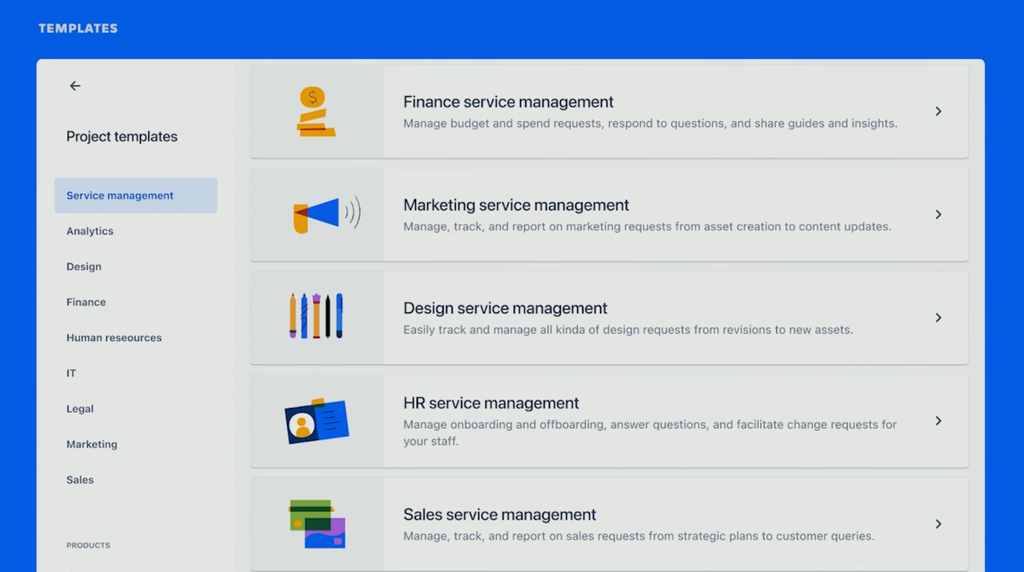
1. Quick setup with flexible templates
JSM offers drag-and-drop editors and pre-built workflows tailored to different teams. The finance department can set up a portal for supplier management. The HR department can automate onboarding requests. The facilities management team can log maintenance work with minimal effort.
2. Multi-channel access
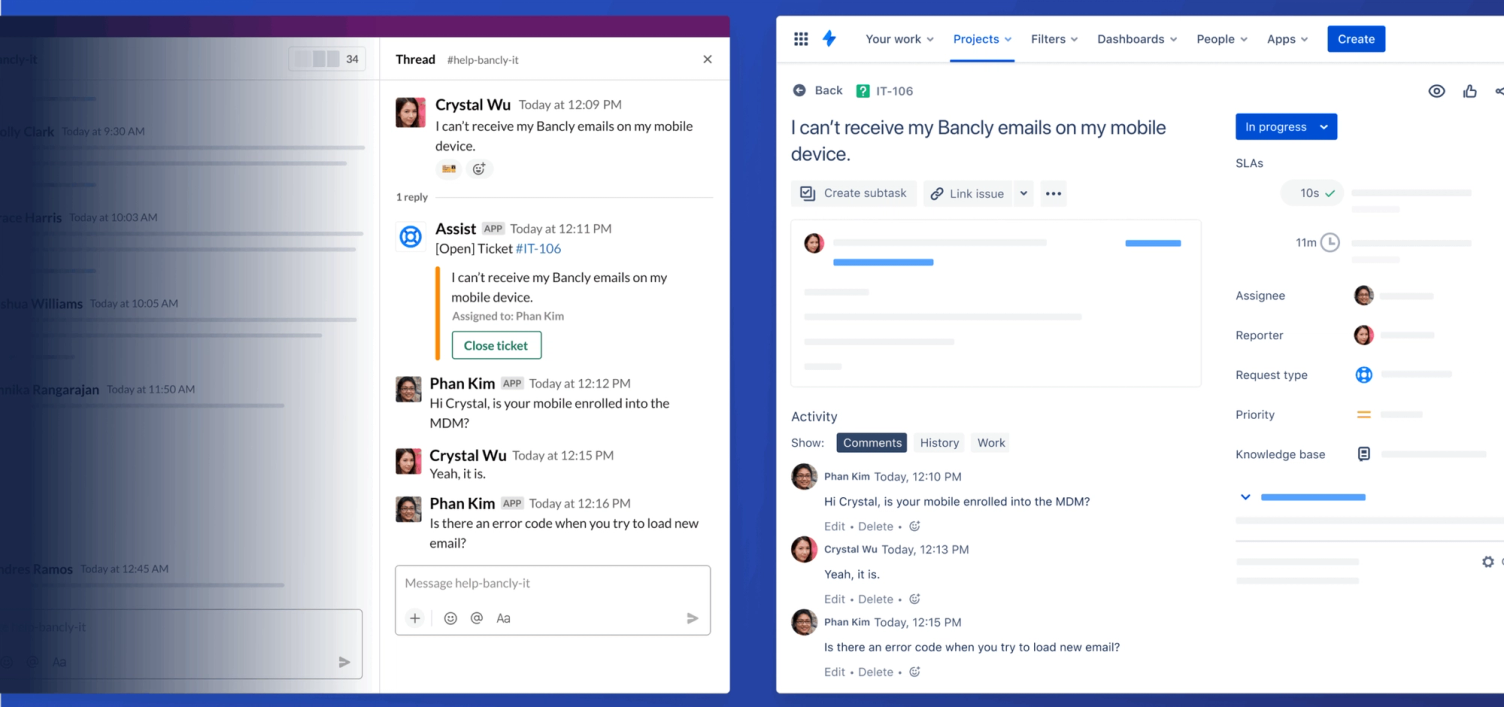
Employees can create tickets via email, chat (Slack or Microsoft Teams), or web portals. There is no need to search for the right contact or tool.
3. Centralised transparency
Managers and stakeholders gain real-time insight into service levels, queues, and ticket status across departmental boundaries. This helps break down silos and ensures everyone remains accountable.
4. AI-powered automation and intelligent workflows
Routine requests are automatically routed to the right employee. Approval workflows accelerate decision-making. Notifications and SLAs ensure that no request falls through the cracks.
5. Integration into the Atlassian ecosystem
By integrating with Jira Software, Confluence, and popular apps such as Workato and Halp, JSM connects workflows end-to-end, from incident to resolution to knowledge sharing.
Atlassian Intelligence & Rovo: The next evolution of ESM
With the introduction of Atlassian Intelligence and Rovo, Atlassian takes Enterprise Service Management to the next level. Rovo is far more than a chatbot: it is an intelligent assistant that automatically understands, assigns, and even suggests solutions for service requests – based on enterprise knowledge from Jira Service Management, Confluence, and other integrated tools.
Through AI-powered automation, Rovo significantly accelerates request handling, reduces error rates, and relieves service teams of routine tasks. Employees benefit from faster responses, self-service options, and personalised support – whether they are working in the office or remotely.
In short: With Atlassian Intelligence, ESM becomes not only more efficient but also future-proof – and businesses are better equipped to meet the growing demands of a digital, AI-driven world.
Enterprise Service Management in practice
Theory is one thing; seeing ESM in practice is quite another. Internal use at Atlassian and customer case studies provide compelling evidence.
HR onboarding at Atlassian
When COVID struck, Atlassian's People Team had to quickly onboard remote employees. By connecting Workday with JSM via Workato, they automated onboarding steps such as laptop provisioning and account setup. The result? Less manual effort, a lower risk of human error, and a smooth, measurable process – which increased team capacity and employee satisfaction.
COVID-19 crisis team
During the pandemic, Atlassian was able to manage employee inquiries regarding policies, travel, and remote work through a central JSM portal. Instead of rumours circulating on Slack, employees received accurate and timely answers through a confidential, structured system, which strengthened trust and prevented unrest.
Workplace
The Workplace Experience Team handles everything from office equipment to employee events. Using JSM's dynamic forms and automation features, they can now seamlessly track issues such as coffee machine repairs and the approval of Kudos gifts, and even provide personal support remotely.
Product marketing campaigns
Product marketing at Atlassian coordinates dozens of stakeholders from various teams. By embedding change management principles in JSM, they avoid bottlenecks, ensure transparent campaigns, and accelerate time to market.
Companies such as Box, Twitter, and AppDynamics also use Jira Service Management in more than 15 departments, transforming traditional service functions into agile, responsive engines.
Practical steps for getting started with Enterprise Service Management using Atlassian
You are probably wondering: “How do I get started? What does my roadmap look like?”
Here are our top tips:
1. Identify high-impact service teams
Start with the HR department, facility management, or the legal department. These teams are overwhelmed with repetitive requests and need automation and transparency.
2. Consolidate tools incrementally
Avoid the creation of new silos by migrating fragmented or outdated systems to a central platform, leveraging JSM's flexible service catalogue.
3. Empower teams with templates and autonomy
Provide user-friendly templates and delegate administrative rights, enabling teams to tailor workflows to their specific needs without IT bottlenecks.
4. Leverage automation and AI
Use built-in automation to route tickets, notify approvers, and trigger SLA escalations. Utilise AI-powered chatbot integrations to offer self-service and knowledge base suggestions.
5. Invest in training and communication
Remember that tools alone cannot solve problems. Engage users through regular training, webinars, and clear communication strategies, much like consumer apps do to maintain high engagement.
Why ignoring ESM is risky
Imagine your competitors scaling their service delivery while your teams juggle fragmented tools and manual workflows. They will innovate faster, retain talent better, and deliver a superior customer experience.
Industry surveys confirm this. Over 75% of companies report a productivity increase after implementing ESM. Many see measurable cost savings as multiple legacy systems are consolidated into a unified portal.
ESM is not just a technology trend. It is a strategic necessity for businesses aiming to succeed in a complex, fast-paced digital landscape.
Summary
Enterprise Service Management with Atlassian is far more than a buzzword; it is a powerful development driven by rising service expectations and digital transformation. By extending ITSM best practices across the entire enterprise, you untangle complexity, reduce costs, and simultaneously boost the satisfaction of your employees and customers.
Atlassian's Jira Service Management is a pioneer in this field, making it easy for any team to create customised service workflows, automate routine tasks, and collaborate seamlessly. Even in a remote world.
Do not let isolated tools and manual bottlenecks hold you back. Embrace ESM and lead your teams towards faster, better, and more transparent service delivery.
Start your Enterprise Service Management project now
Are you ready to take your service delivery to the next level? With Jira Service Management and Atlassian Intelligence, you can create a central platform that connects teams, automates processes, and revolutionises service experiences.
Whether it's your first use case or a comprehensive ESM strategy – we support you from analysis to successful implementation.
Book a no-obligation consultation now and find out how ESM with Atlassian can sustainably transform your business.