Barcelona, new ideas, and a lot of “AI in action”: Our team was on the ground at Atlassian Team’25 Europe. Here, we summarise the biggest announcements around Rovo and the Teamwork Graph in the first part.
Atlassian’s transformation into an AI platform company
The announcements made at Atlassian’s Team '25 Europe in Barcelona, particularly those by visibly energised co-founder Mike Cannon-Brookes, signal the culmination of a multi-year strategic realignment. Atlassian has completed its transformation from a provider of market-leading but often siloed software tools to an AI-native software company. This development is driven by a central principle known as the “System of Work”. This is a framework designed to break down traditional barriers between business and technology teams to create a single, unified operating structure. Atlassian is now primarily a developer of AI tools for teamwork.
The cornerstone of this new strategic direction is Rovo, an AI solution that has evolved from a set of features into an omnipresent intelligence layer across the entire platform. Rovo is not just an “AI assistant”, but the intelligent engine driving the System of Work. The mantra “Rovo knows everything, is everywhere, and is there for everyone!” encapsulates this vision of an omnipresent, knowledgeable AI team member embedded in all apps of the Atlassian ecosystem.
The concrete implementation of the System of Work is achieved through “Collections”: curated packages of applications and AI agents specifically developed for certain business functions. The general availability of the new Software and Service Collections, along with significant improvements to the existing Atlassian Teamwork and Strategy Collection, marks a decisive shift from selling individual products to providing holistic solutions.
This entire transformation is based on an enterprise-grade cloud platform. After more than a decade of development, the Atlassian Cloud has matured and is supported by massive investments in scalability, security, and governance. The introduction of new deployment options such as Isolated Cloud and the concept of Units was specifically designed to meet the stringent requirements of the largest and most heavily regulated enterprises, signalling that the platform is ready for any business challenge.
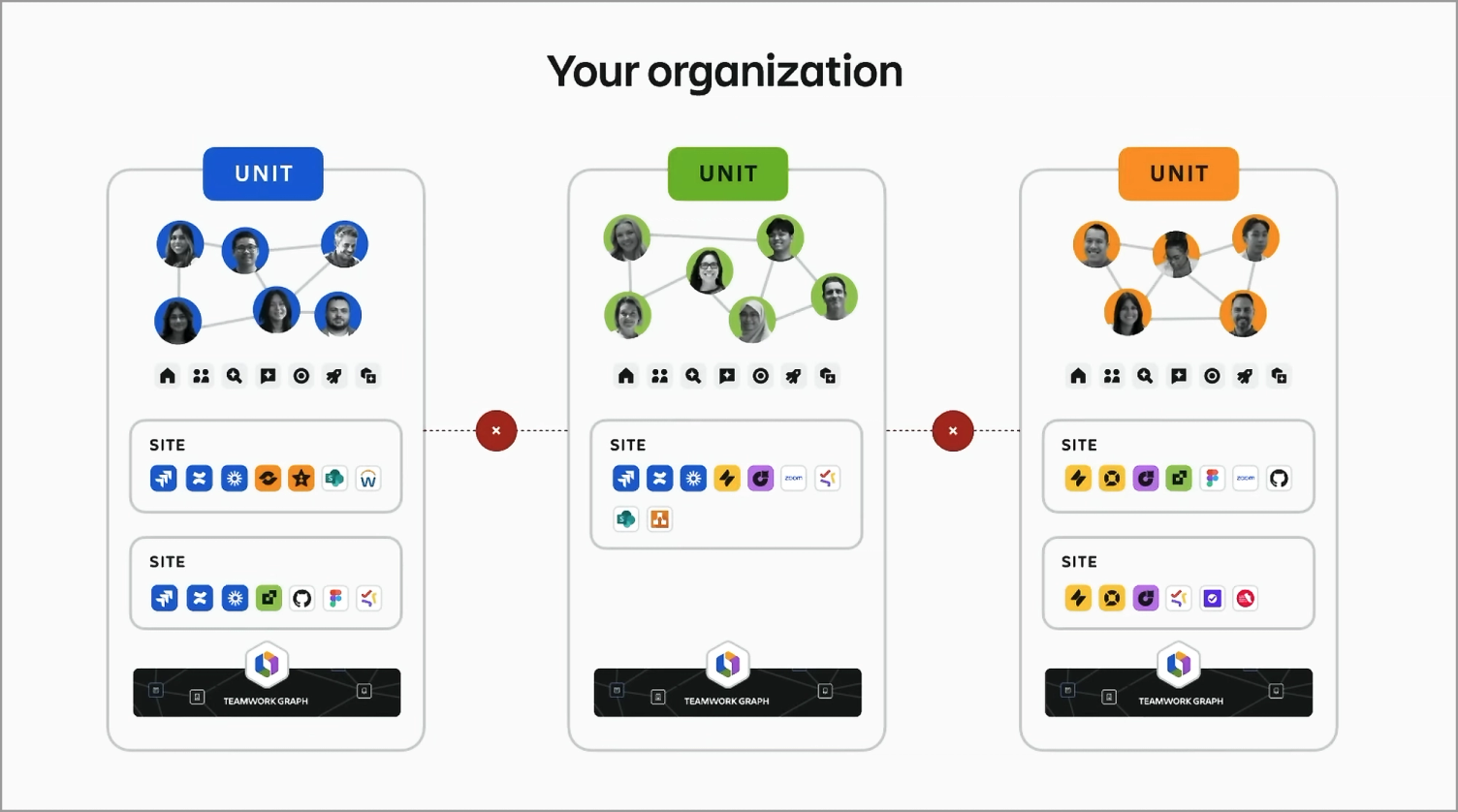
These developments indicate a fundamental change in competitive strategy. The focus is no longer on the superiority of individual product features, but on the integrated intelligence of the entire platform. The value proposition now relies on the synergy created by Rovo and the underlying Teamwork Graph, which aggregates information from all connected tools to create a holistic and intelligent working environment. This positions Atlassian not only as a competitor to point solutions but also to comprehensive work platforms like Microsoft 365, with the goal of becoming the central nervous system of modern enterprises.
The Rovo ecosystem: Atlassian’s AI engine
Rovo is Atlassian's most significant strategic initiative and functions as a unified AI layer embedded across all cloud products. It is designed as the primary interface through which teams interact with their collective knowledge, and as an engine that automates complex workflows.
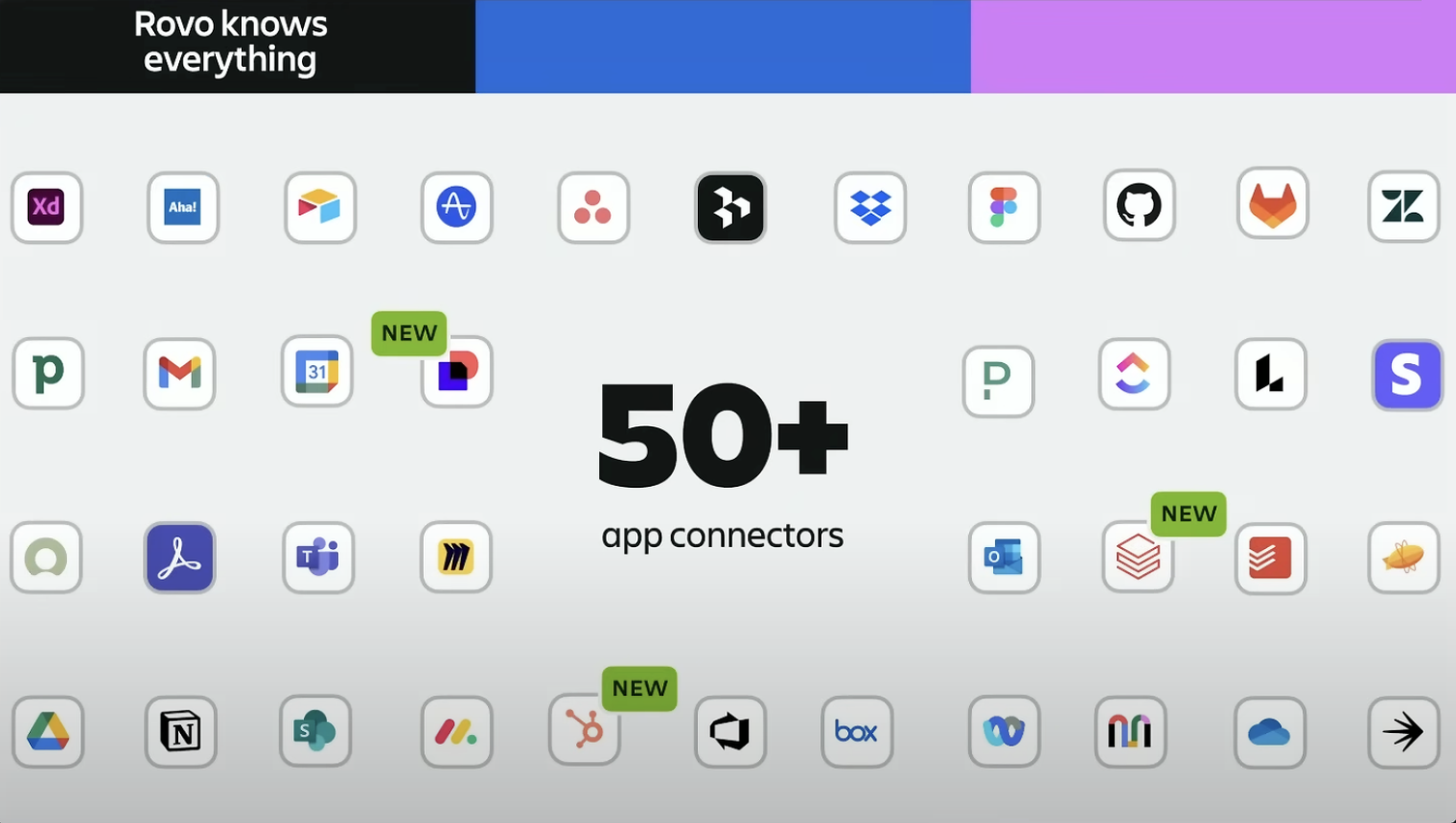
Rovo knows everything, works everywhere, and helps everyone
Rovo fundamentally changes the way users interact with the Atlassian platform, shifting the focus from manual navigation and search to a conversational, action-oriented approach.
Rovo Search: Rovo Search is now the default search function in Jira and leverages the intelligence of the Atlassian Teamwork Graph along with a growing library of over 50 connectors – including new additions for AWS, Salesforce, GitBook and HubSpot – to deliver highly personalised and context-aware results.
Surveys show that 78% of users find the results more accurate than those of other tools. It offers not just links, but also “intelligent answers” that summarise information and suggest relevant follow-up questions.
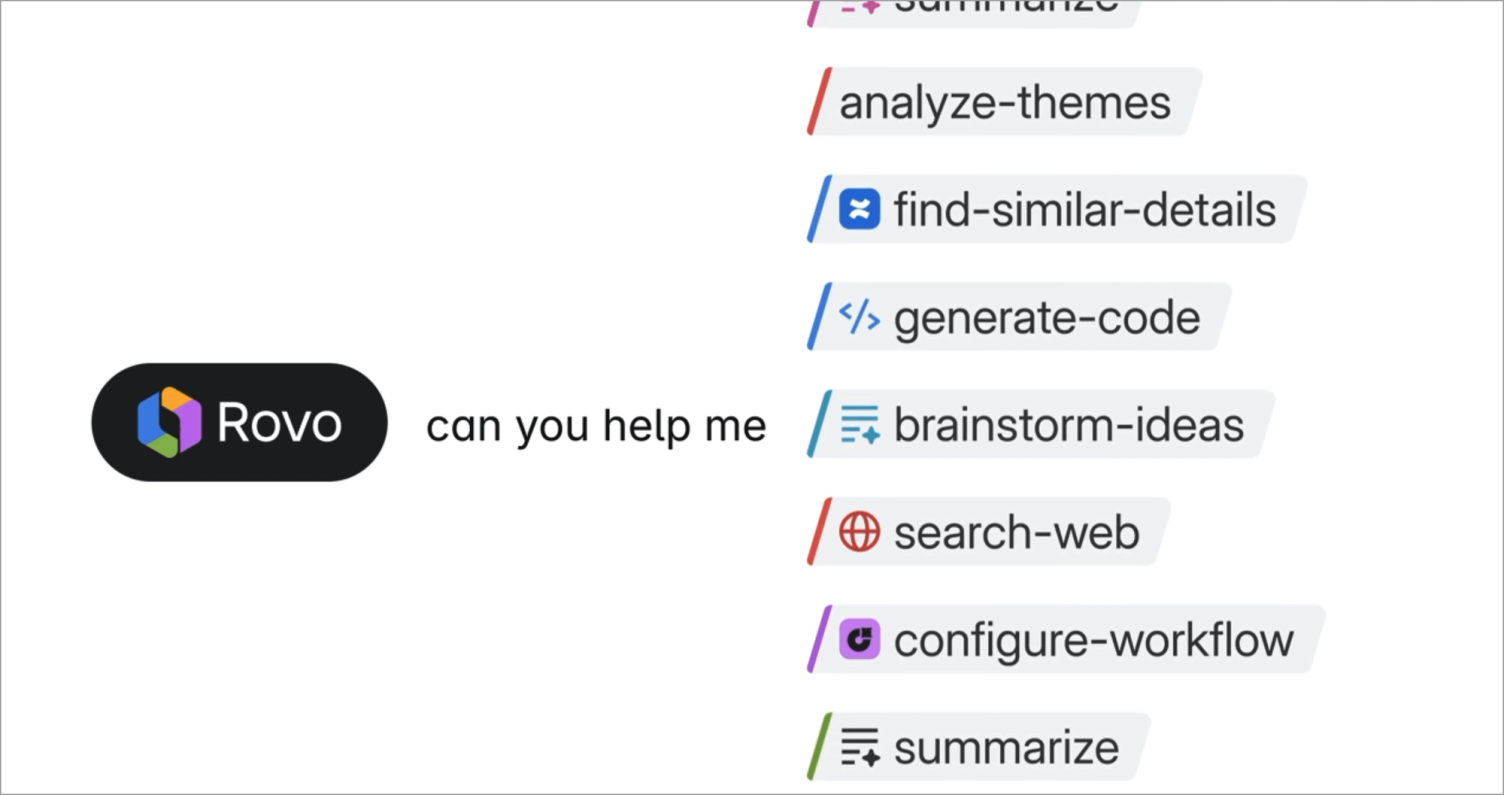
Rovo Chat: This conversational frontend functions as a collaborative workspace. It goes beyond a simple question-and-answer bot, by incorporating personal memories to tailor responses individually, enabling multimodal inputs such as files and images, and featuring a “Skills” directory with over 100 ready-to-use functions that can be invoked to perform direct actions, such as creating an email or searching the internet.
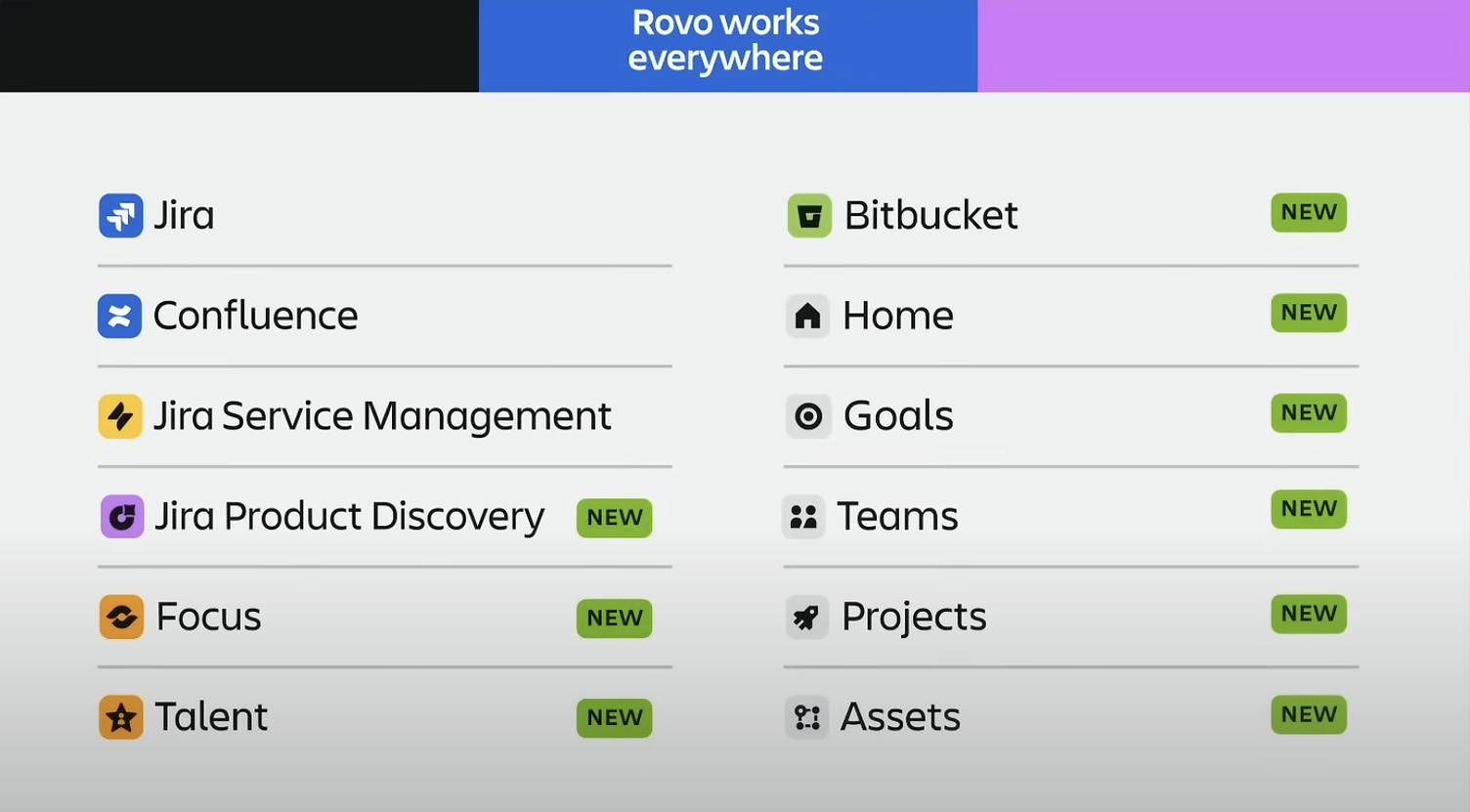
Ubiquitous Access: A core principle of the Rovo strategy is its ubiquitous availability. It is integrated into nearly all Atlassian cloud products and, crucially, into all pricing tiers, including Standard.
Furthermore, Rovo's AI features are accessible at every user touchpoint through dedicated desktop and mobile applications, making it a constant and available teammate.
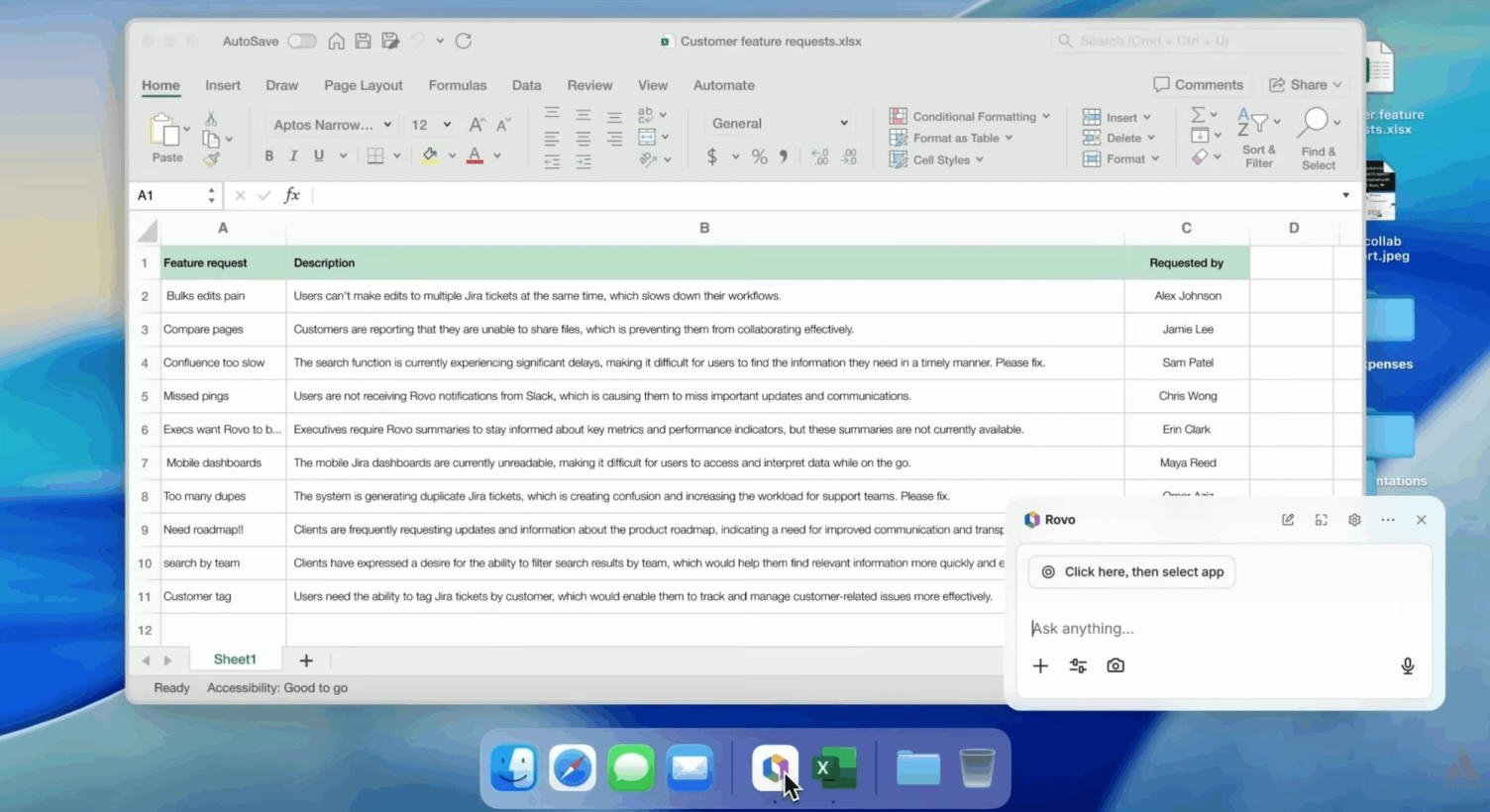
Rovo as an agent-based automation engine
Rovo facilitates the transition from simple, trigger-based automation to proactive, “agent-based” workflows, in which AI can take on complex, multi-step tasks.
- Rovo Agents: These are specialised AI team members designed to perform specific functions. They can be invoked directly in editors (using the /ai command), integrated into Atlassian automation rules to optimise existing workflows, or tasked with coordinating entire business processes from start to finish.
- Rovo Studio: The announcement of Rovo Studio marks a pivotal moment in the democratisation of AI development on the Atlassian platform. It is a no-code/low-code builder that allows any user, regardless of their technical skills, to create their own custom agents and automations. An upcoming feature will even allow users to “vibe-code” production-ready Forge applications using plain English, drastically lowering the barrier to creating powerful, tailored solutions that are securely hosted on the Atlassian platform. This internal development feature provides a powerful alternative to the Atlassian Marketplace for creating smaller, customised solutions and gives companies greater control over their tools and security posture.
- Advanced Orchestration: The platform's capabilities are further enhanced by a library of pre-built skills and support for advanced orchestration logic, enabling the creation of sophisticated, multi-step and even parallel branching processes that reflect complex business workflows. This represents a fundamental shift in the relationship between users and software, moving away from a model where the user controls the software, towards a model where the user collaborates with a team of specialised human and AI agents, delegating outcomes rather than executing individual steps.
Specialised agents for core business functions
Atlassian has launched several purpose-built Rovo agents that serve as the intelligent core of its software and service collections, demonstrating the practical application of agent-based AI. Read more about Rovo Dev, Rovo Service & Rovo Ops.
Enterprise-grade trust and governance
To address the most critical concerns of businesses regarding AI security and data privacy, Rovo is built on a foundation of trust. Atlassian hosts its own large language models (LLMs), offers customers the option to use individually managed keys for encryption, and provides administrators with detailed control over access to AI features and agent usage permissions.
The platform architecture includes the Model Context Protocol (MCP), which acts as a secure bridge to external AI tools and models, ensuring that all data interactions remain subject to Atlassian's robust security framework.
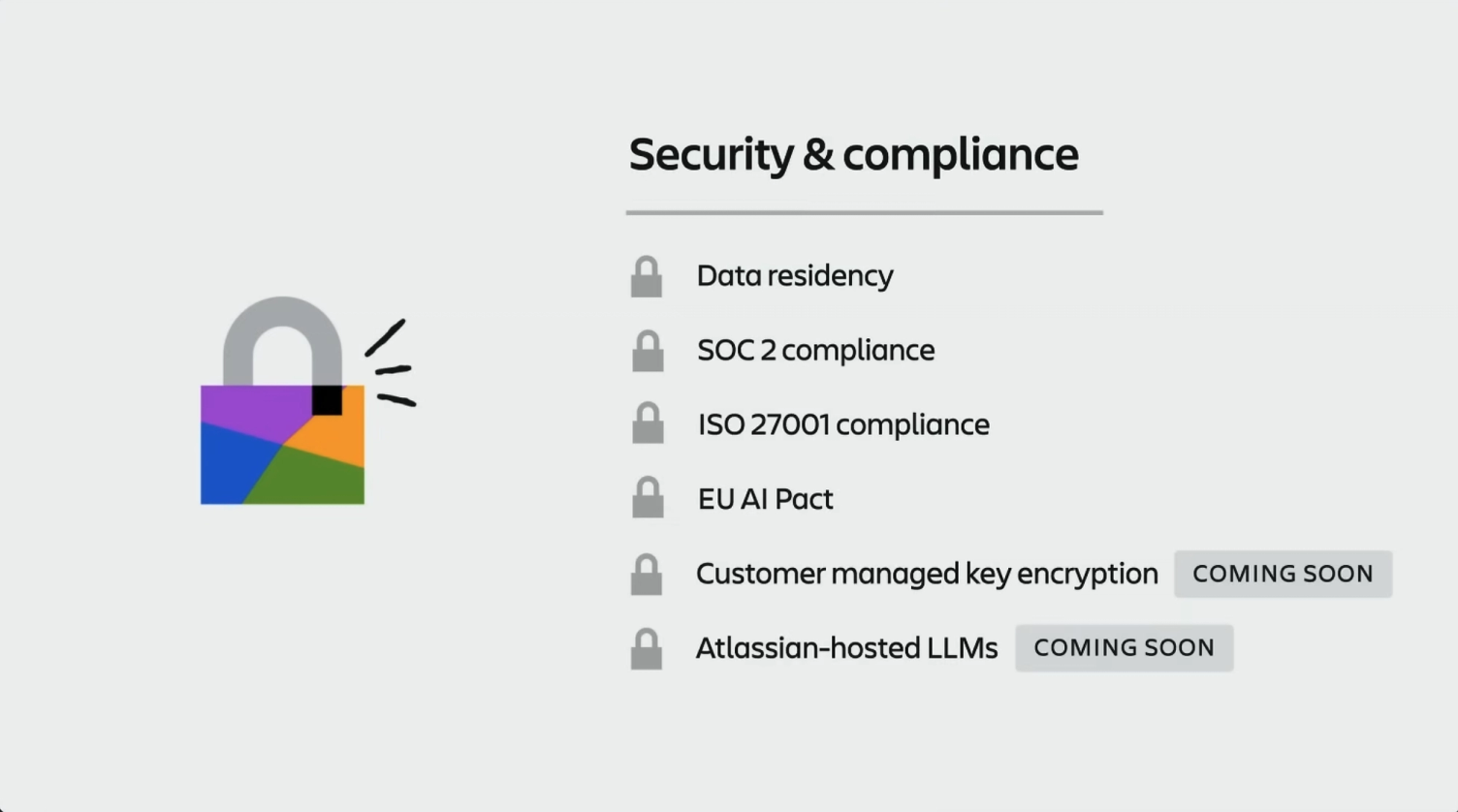
The Teamwork Graph: The open data layer
The Teamwork Graph is the intelligent data layer that connects people, projects, and knowledge across the entire Atlassian platform, forming the technical core of the system of work. It currently maps over 10 billion objects and their relationships.
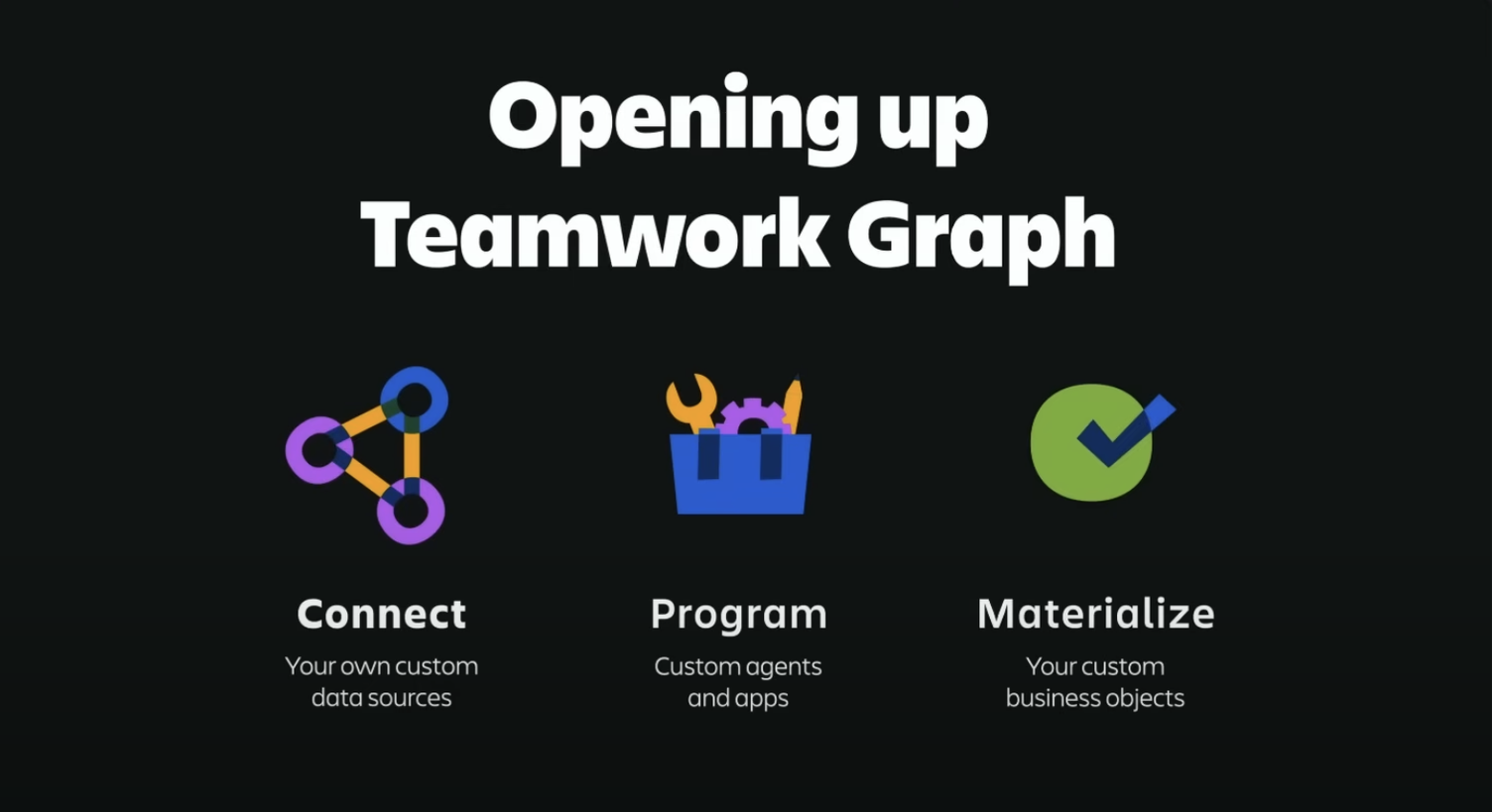
- Opening up the Graph: Atlassian is making the Teamwork Graph available, allowing other systems to access it via APIs. This gives developers and partners programmatic access to the rich, contextual data layer that powers Rovo. This decision transforms Atlassian from a closed application provider into a true development platform, enabling the creation of a new ecosystem of hyper-intelligent custom applications on its data foundation.
- Expanding connectivity: The Graph is becoming stronger with new connectors for proprietary data sources, and “Assets” is now a platform-level service – allowing asset objects to be embedded and linked in any Atlassian app.
Atlassian investments 2025
- Cycle (Sept 2025): A feedback and product discovery tool to enhance Jira Product Discovery.
- Browser Company (Sept 2025) with Dia Browser: The strategic idea is to reinvent the browser for knowledge work. Dia is the AI-centric browser from The Browser Company. Unlike classic browsers that integrate AI only as an add-on, in Dia AI is a core component: Chat & Assistant are directly in the browser window, understand the open tabs, and provide answers, summaries, and actions “in context” – without tool-hopping.
- DX (Sept 2025): An engineering intelligence platform that helps teams measure and improve developer productivity (-> in the Software Collection - Compass & DX will merge).
- Borneo.io (May 2025): an enterprise-grade security and privacy observability platform that helps businesses identify, understand, and directly address risks associated with sensitive data (-> enhances features and functions of Atlassian Guard).
The future is an AI-powered, unified workflow
Atlassian did not just showcase many individual features at Team’25 Europe (and before that), but a clear, coherent strategy. Goal: moving away from individual tools towards holistic solutions. Rovo is at the center as the AI engine. Together with the Collections, Rovo is set to dissolve the separation between development, IT, and business.
The core message: unify and empower. Team leads and project managers get the right tools and information to align their teams' work directly with business goals. Instead of scattered, separate tools, a common system of work emerges where context flows and AI makes work smarter in many places.
The Atlassian Cloud is ready for this: scalable, secure, and compliant – proven for years. With Atlassian Ascend, there is a clear migration path. In short: now is a good time to switch to unified, AI-powered collaboration.
How XALT supports
We support you end-to-end: from cloud migration to AI use cases with Rovo, service transformation, developer workflows, and strategy & workforce planning.
On request, including a scoping workshop, piloting in 20 days, and clear success metrics.
Team'25 Europe news on the Atlassian Collections and the Cloud