Imagine the entire journey of your product, from the first idea through development to final packaging and marketing, running like a perfectly synchronised clockwork. No waiting for manual handovers, no error-prone double data entry, no unclear responsibilities. All departments collaborate within a single, shared system.
Sounds like a utopia? In many companies, reality is different: fragmented tool landscapes, countless Excel lists and manual processes that devour valuable time and stifle innovation.
Such opaque processes are not only frustrating but also cost valuable time, hinder productivity and can ultimately jeopardise business success.
Where manual and isolated processes are paralysing your business
The true cost of inefficient, manual workflows is often higher than one might initially assume. Do these challenges sound familiar?
- Cost pressure & blown budgets: Many organisations have to make savings. Those who operate too many systems struggle with inefficiencies due to media breaks between tools and inevitably incur high licensing and operating costs.
- Loss of productivity & high error susceptibility: Where humans perform manual, repetitive tasks, errors occur. Incorrectly transferred data can lead to costly production errors or misdirected marketing campaigns. Moreover, no one enjoys tedious “copy-paste” tasks. Valuable specialists are blocked by administrative work instead of focusing on strategic and creative activities that truly drive the company forward.
- Information chaos & endless coordination loops: Information is forwarded by email, gets lost or becomes outdated. Teams waste productive time searching for information, and coordination between product development, marketing and sales becomes a daily battle.
- Bottlenecks & lack of scalability: The company grows, but the processes do not keep up. Every new employee and every new project exponentially increases the manual effort and leads to the collapse of workflows. Employees wait a long time for support and SLAs are breached.
- Security & compliance gaps: Without standardised processes, clear approval workflows and transparency, audits become stressful and risky.
- Low user adoption: Changes within work systems and processes are often underestimated. If people do not use the new system, you will not achieve the promised results and costs will continue to pile up.
According to McKinsey, good cross-departmental collaboration increases team productivity by up to 30 %.
The solution: The Atlassian System of Work as a bridge between departments
The Atlassian System of Work (SoW) is a central approach that effectively brings together teams, tools, and knowledge. In a world where efficiency, transparency, and collaboration determine success, it provides exactly the answer that modern businesses need.
What is the System of Work?
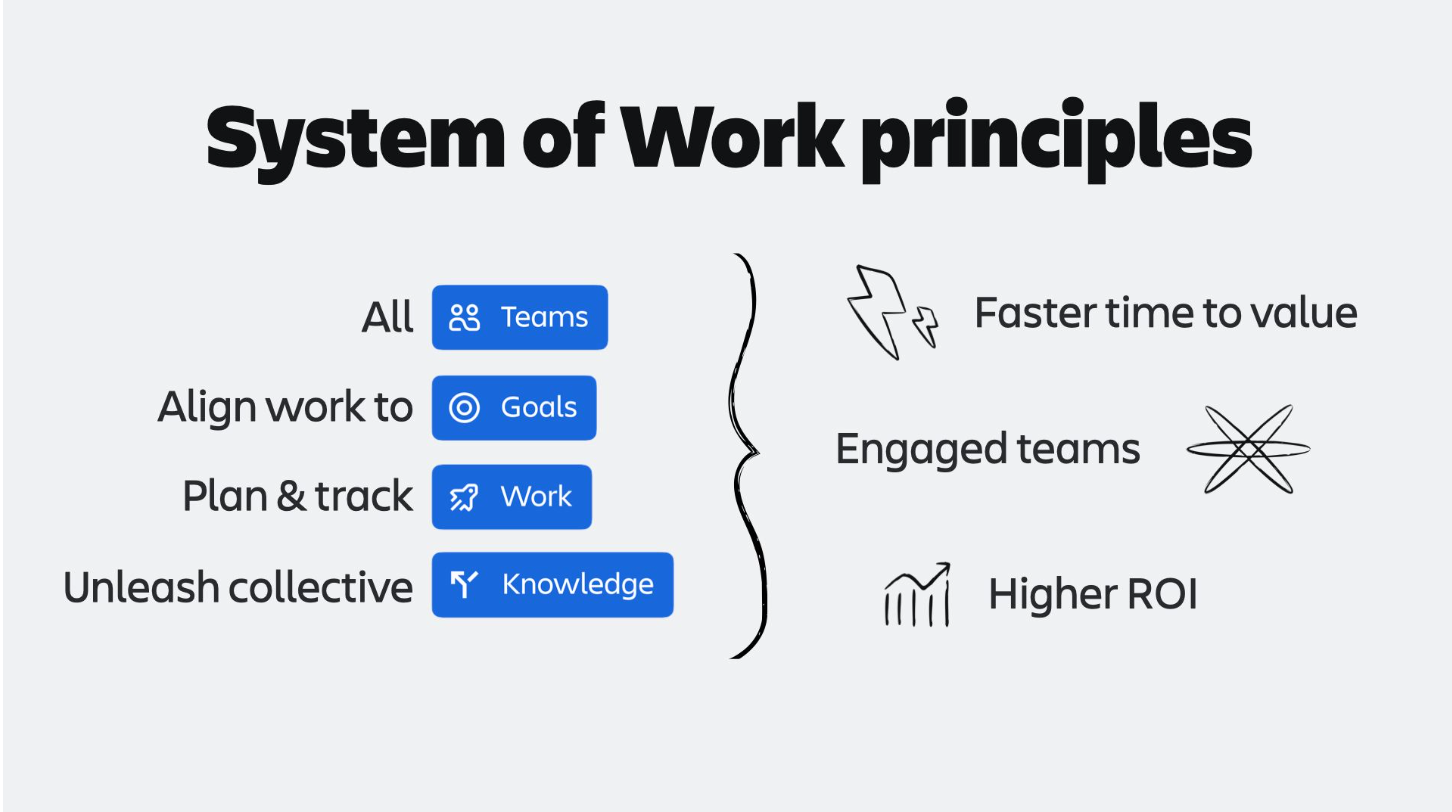
The System of Work offers a shared work philosophy for all departments: development, IT, marketing, HR. It connects strategy, tools, knowledge, and processes across platforms and is based on four core principles:
- Work to goals – Work is aligned with business objectives.
- Plan & track together – Task planning and tracking are carried out in an organised, cross-team manner.
- Unleash collective knowledge – Shared knowledge is documented, shared, and made usable.
- Realize AI teammates – Artificial intelligence becomes part of the team, driving efficiency and innovation.
How does Atlassian implement this technologically?
Atlassian's portfolio – Jira, Confluence, Rovo, Loom, and others – is integrated into a seamless ecosystem. This eliminates redundancy and makes knowledge centrally accessible.
The Atlassian tool suite is specifically designed for cross-team collaboration, for example through
- Jira as the central hub: Jira allows you to plan, track, and manage projects and tasks across departmental boundaries. This ensures that all stakeholders always have an overview of the current status and their responsibilities.
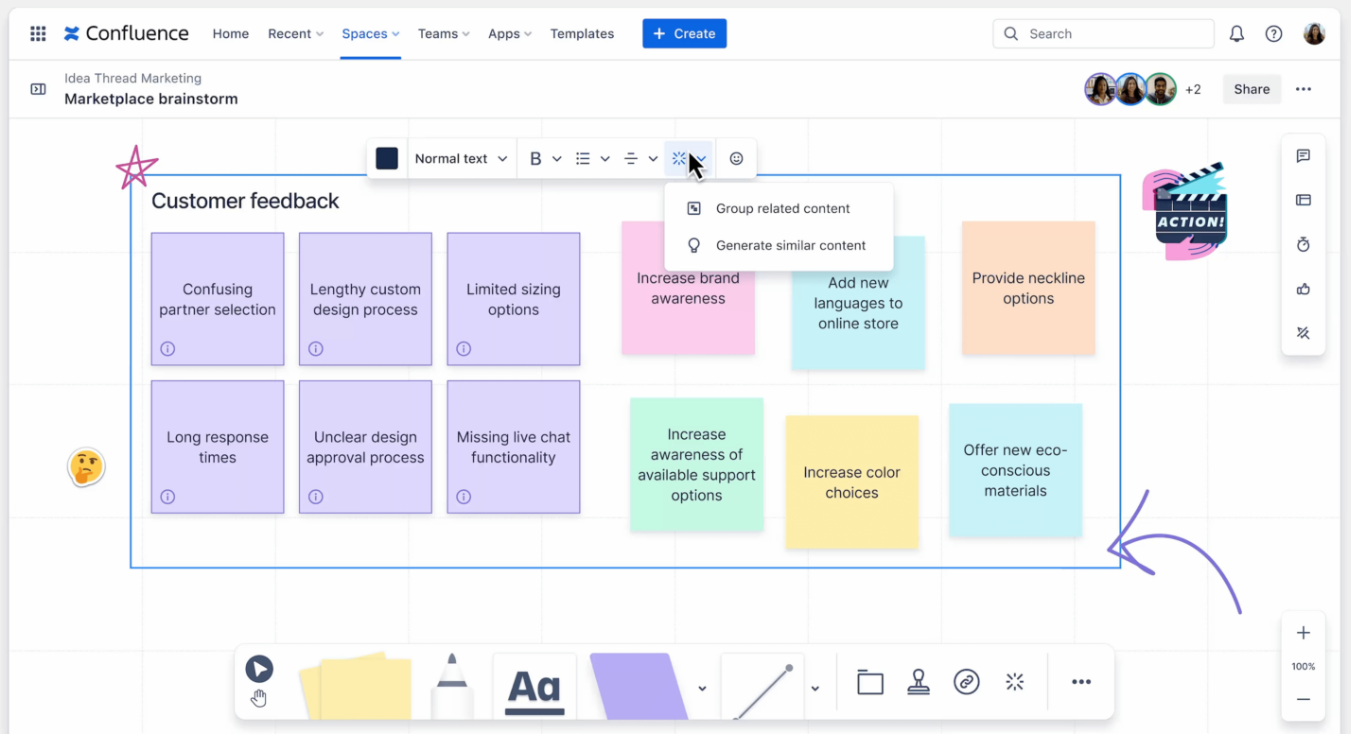
- Confluence as the knowledge hub: In Confluence, teams can centrally document and share their knowledge. This creates a unified information base and prevents important information from being lost in email inboxes or on local drives.
- Integration for a smooth workflow: Atlassian products are seamlessly integrated with one another, ensuring a fluid and efficient workflow. This also forms the foundation for the AI-powered Rovo chatbot, which can provide teams with summaries and further links to projects across applications and within seconds, so they do not waste unnecessary time searching for information.
The Teamwork Graph: The heart of the System of Work
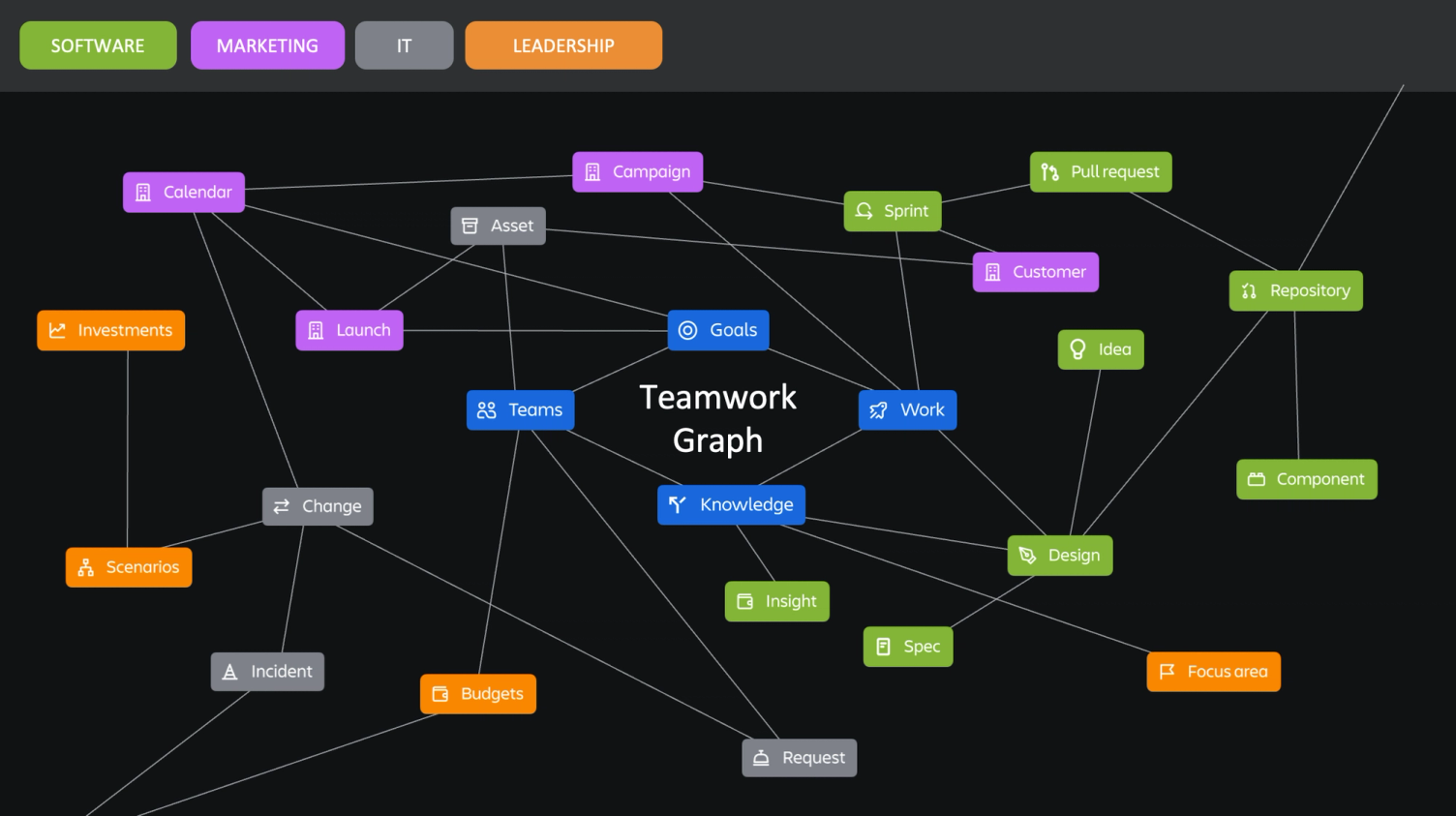
Imagine every piece of information, every project, every task, and every person in your company being connected through an invisible, intelligent network. This is exactly what the Teamwork Graph achieves – the data and context layer that makes the Atlassian System of Work so powerful.
While conventional tools often function only as isolated data silos, the Teamwork Graph connects all relevant work content, regardless of whether it comes from Jira, Confluence, Rovo, Bitbucket, or third-party applications. It recognises relationships between tasks, documents, goals, and the people working on them.
Here is how the Teamwork Graph works in practice:
- Connectivity instead of fragmentation: Information from different systems is automatically consolidated.
Example: A service team is working on a Jira ticket regarding a system error. The Teamwork Graph recognises that there is already a Confluence document with a similar error analysis and embeds it directly in the ticket, including the contact person from the DevOps team. - Context on demand: Work is not only documented but contextualised.
Example: An HR team is planning the onboarding of a new employee. Checklists, approval processes and internal policies from Confluence relevant to this role automatically appear in the Jira onboarding task – without anyone having to search for them. - Intelligent recommendations: Through semantic analysis, the graph identifies which information, contacts or content are needed in a specific work step and provides them proactively.
Example: A project manager creates a new Jira epic for a client project. The Teamwork Graph automatically suggests similar, completed projects, including lessons learned, templates used, and the colleagues who worked on them. - Real-time overview: Dependencies, progress and bottlenecks are made transparently visible – across teams and role-based.
Example: In a programme manager's dashboard, all ongoing projects are displayed. The Teamwork Graph automatically marks dependencies between two projects that require the same developer and warns of potential delays before they occur.
The benefits for businesses:
- Breaking down silos: Knowledge is made visible where it is needed, regardless of the source tool (no media breaks).
- Faster decisions: Because context and relevant data are immediately available (valid real-time data).
- Greater team autonomy: Self-service features enable finding answers and solutions without detours (less work interruption due to inquiries).
- Seamless connection between strategy and execution: Business goals are directly linked to operational tasks, making progress measurable and traceable (ROI and productivity are traceable).
The Teamwork Graph is therefore not just an "add-on", but the engine for a connected, intelligent and future-proof way of working. It ensures that the System of Work does not stop at pure tool integration, but delivers real, measurable value – in the form of higher productivity, better collaboration and a clear connection between goals and results.
The impact of the System of Work in numbers
In times of scattered tools, remote work and the AI breakthrough, the SoW offers a structuring, scalable framework for modern collaboration. Atlassian is investing heavily in cloud infrastructure, the Teamwork Graph, AI and automation to provide a clear answer to the challenges of hybrid work.
- Project success rate increases from 57% to 75%.
- Interruptions decrease by 35%.
- Time-to-value is accelerated by 40%.
XALT: Your partner for process automation
The introduction of a central platform is a strategic project. As an Atlassian Platinum Partner, XALT helps you not only with the technical implementation. We jointly analyse your existing workflows, identify the biggest pain points and optimisation potential, and design a system perfectly tailored to your company's needs and roadmap.
Say goodbye to process chaos. Create a fully automated, central system with Atlassian and XALT where your teams collaborate seamlessly and drive innovation together.